


Baikal, also known as Lake Baikal, is a massive and ancient freshwater lake located in the mountainous region of Siberia, near the Mongolian border in Russia. It is renowned as the world’s deepest and oldest lake, holding about 20% of the Earth’s unfrozen freshwater and boasting unique biodiversity, including the endemic Baikal seal (nerpa). A UNESCO World Heritage Site, Baikal is celebrated for its incredibly clear water, stunning surrounding mountains, and year-round activities such as hiking, ice-skating in winter, and wildlife viewing.
Baikal is a pearl among the lakes of the world. It holds unmatched records of being the deepest lake on earth—over 1,600 metres—and the oldest, dating back 25 to 30 million years. It contains roughly one-fifth of the world’s fresh surface water. Formed in a rift valley where the Earth’s crust is gradually pulling apart, Baikal is home to thousands of endemic species, including the nerpa seal, the transparent golomyanka fish, the omul fish, and unique sponges. Its waters are exceptionally clear thanks to filter-feeding organisms like Epischura zooplankton and endemic sponges that constantly purify the lake.

Scientists also describe Lake Baikal as a “young ocean in the making.” The rift beneath it continues to widen slowly, suggesting that millions of years from now it could evolve into a new ocean basin. Its underwater terrain—featuring cliffs, ridges, and canyons—already resembles that of deep marine environments, highlighting its extraordinary geological nature.
In modern times, Baikal’s significance has attracted scientists studying biology, hydrology, climate history, and even neutrinos, taking advantage of its clear water and deep ice. Tourists flock to destinations such as Listvyanka village, Olkhon Island, and the Great Baikal Trail. In winter, the lake freezes into astonishingly clear, solid blue ice that supports skating, dog sledding, and even temporary winter roads for vehicles.
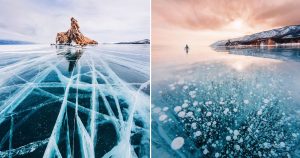
The lake’s winter transformation is particularly dramatic. Crystal-clear ice allows visibility far beneath the surface, while long cracks echo like thunder as the plates shift. Massive blocks of blue ice push upward to form hummocks—natural sculptures that draw photographers from around the world. Despite freezing over, the lake retains its life below, with fish visible through the transparent surface.
Baikal’s immense size shapes its own microclimate. Winters around the lake are slightly warmer than the rest of Siberia, while summers remain cooler. Fog often lingers above the water, creating an ethereal, almost mystical atmosphere that enhances Baikal’s sense of isolation and beauty.
For the indigenous Buryat people, Baikal is more than a natural wonder—it is sacred. They regard it as a living spirit, and Olkhon Island remains the cultural and spiritual heart of the region. Traditional shamanistic rituals are still practiced there, and stories, legends, and ancient beliefs tied to Baikal have been passed down through generations, deepening its spiritual and cultural resonance.
Beneath the surface, Baikal hosts rare ecosystems not found anywhere else on Earth. Freshwater hydrothermal vents release mineral-rich, heated water that supports unique microorganisms able to survive extreme conditions. Vast stretches of the lakebed are covered in green sponge forests that filter the water and play a crucial role in its clarity and ecological balance.
The lake’s weather can be unpredictable. Calm conditions can change within minutes, producing sudden storms across the surface. Baikal also experiences seiches—standing waves caused by atmospheric pressure changes—that can rise unexpectedly without any wind, long observed by local fishermen and mariners.
One of the lake’s most striking natural phenomena is the “Baikal Zen” effect. During winter, stones on the frozen surface become elevated on delicate ice pedestals as the sun melts the ice around them, leaving them perfectly balanced as if suspended. These formations appear surreal and remain one of the lake’s most photographed winter features.
Baikal is also an invaluable climate archive. Its sediments contain millions of years of environmental information, allowing scientists to study long-term climate changes with remarkable precision. The lake’s clarity and depth have even made it suitable for advanced physics research, such as neutrino detection experiments.
Interestingly, in 1982, a team of Soviet Navy divers conducting training exercises at around 50 metres depth reported encountering strange humanoid beings underwater—an account that remains one of the lake’s most persistent modern mysteries, adding an element of folklore to its scientific profile.
Despite its purity, Baikal faces serious threats from industrial pollution, illegal logging, invasive species, overfishing, and the growing impact of climate change on its delicate ecosystem. Endemic species such as the omul, Baikal sturgeon, and unique sponge communities are increasingly vulnerable. Conservationists and environmental groups continue to advocate for stronger protections to preserve Baikal’s irreplaceable ecosystem.
In essence, Baikal is a global natural treasure—a place where geological wonder, cultural tradition, scientific discovery, and natural beauty converge. Its immense ecological importance, combined with its ancient origins and unmatched biodiversity, makes it one of the planet’s most extraordinary freshwater environments.
Source: Internet






Leave a Reply