

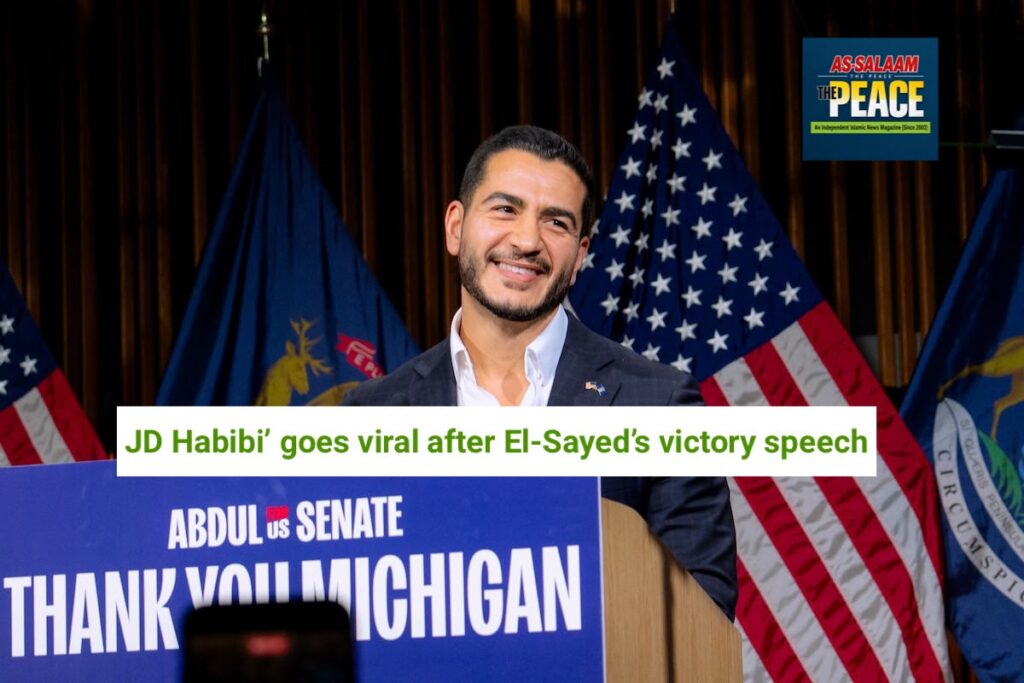
Michigan senator-elect addressed Vice-President JD Vance with an Arabic term of endearment during his victory speech, turning a brief exchange into a viral moment celebrated across the Arab world.
By Abdullahi Yusuf
Two words from Abdul El-Sayed’s victory speech in Michigan have travelled far beyond American politics, with “JD, habibi” becoming a widely shared phrase after the Democrat’s historic election to the United States Senate.
Addressing Vice-President JD Vance, El-Sayed used the Arabic term of endearment to highlight what he described as the “delicious irony” of Vance being expected to swear him into office when the new Congress convenes in January.
“JD, habibi, there is this delicious irony in the fact that you’re constitutionally obligated to swear me in in January,” he told supporters in Detroit, drawing laughter and cheers.
The remark was a pointed response to Vance, who had criticised El-Sayed during the campaign and warned that he would lead rioters in burning down Detroit. El-Sayed’s election victory means he is set to become the first Muslim American elected to the US Senate.
The phrase quickly spread across social media, with supporters sharing video clips, memes and music edits. Its reception extended beyond the United States, particularly across Arab countries and diaspora communities, where audiences celebrated the use of Arabic in a defining moment of American electoral politics.
The Arabic word “habibi” literally means “my beloved”, but is also commonly used in everyday conversation to mean “my dear”, “buddy” or “pal”. Its meaning can shift with context, making El-Sayed’s use of it both affectionate and teasing.
The moment carried added significance because El-Sayed had faced attacks over his name, faith and heritage during the campaign. President Donald Trump and other Republican figures had used anti-Muslim language against him, including calling him a “jihadist”, an allegation he rejected.
Rather than avoid references to his background, El-Sayed incorporated Arabic expressions and Islamic phrases throughout his victory address. He began by recalling how he had repeatedly used “inshallah”, meaning “God willing”, during the campaign, before telling supporters that the result had turned it into “alhamdulillah”, meaning “praise be to God”.
The speech also included a direct response to Trump, whom El-Sayed said had struggled with his name. After Vance swore him in, he told the president, Trump could simply call him “Senator”.
For many Arab audiences, the exchange offered a moment of celebration amid years of political rhetoric and public suspicion directed at Arab and Muslim communities in the United States. The Associated Press reported that supporters across the Middle East welcomed El-Sayed’s use of Arabic expressions, sharing music clips and other social media posts inspired by the speech.
El-Sayed, the son of Egyptian immigrants, has made his faith and heritage visible throughout his political career. His victory has also placed renewed attention on the participation of Muslim Americans in national politics, particularly as candidates from minority communities continue to face scrutiny over their identities.
His election, however, extends beyond the symbolism of becoming the first Muslim American senator. In his victory speech, El-Sayed called for reducing the influence of money in politics, putting more money in people’s pockets and pursuing universal healthcare through Medicare for All.
He also defended his position on Palestine, saying that believing Palestinian children should be able to live with peace, dignity and self-determination was not an expression of hatred.
The “JD Habibi” moment has since become one of the most recognisable extracts from his victory address. What began as a humorous exchange with the vice-president has become a wider cultural moment, placing an Arabic expression at the centre of a historic American political victory.
Leave a Reply