


By: Dr. Huseyn Zakaria
Gaza is scarcely a strip on the map, yet it has become one of the loudest moral questions of our generation. For more than seven decades, its people have lived under daylight assassinations, indiscriminate bombardment, merciless blockade, and collective political abandonment.
The world calls each eruption of violence a “war” and every butchering of children, the elderly, and women “self-defence”. Yet such words conceal nothing; they expose the imbalance and reveal the true nature of Zionist aggression. Whenever a besieged population, without an army, navy, air force, or modern arsenal, is bombarded by one of the best-equipped militaries on earth, it is not war — it is the crushing of a trapped community.
Even after a fragile ceasefire, the assault leaves behind pools of blood, unidentified and mutilated bodies, hospitals without power, and schools reduced to dust. United Nations figures speak of tens of thousands of lives lost or maimed, yet statistics cannot capture the destruction of hope or the humiliation of a people forced to count their children as “collateral damage”.
A Vocabulary of Horror:
Writers have searched for words large enough to contain what Gaza has endured: massacre, wholesale killing, mass slaughter, bloodbath, butchery, pogrom, ethnic cleansing, holocaust, shoah, bloodletting. None are exaggerations. They describe an industrial scale of death that empties entire neighbourhoods. Humanitarian agencies report streets lined with rubble, families huddled in tents beside the ruins of their homes, and a generation of children whose vocabulary now includes drone, air-strike, and siege.
To speak of annihilation is not rhetoric; it is the precise description of a policy of erasure. Gaza’s farmland lies scorched, its water undrinkable, its borders sealed. Livelihoods have been eliminated, hospitals liquidated by bombardment, universities eradicated as though education itself were a threat. What language remains when survival itself becomes resistance?
Engines of Complicity:
None of this occurs in isolation. Military hardware, diplomatic cover, and financial backing flow freely from powerful capitals. Successive American administrations have stood as guarantors of Israel’s security, rarely of Palestinian safety. During Donald Trump’s tenure, that support was not merely rhetorical; it became open cheques, accelerated arms deals, and political recognition that emboldened hard-liners. The consequences are visible in every collapsed apartment block.
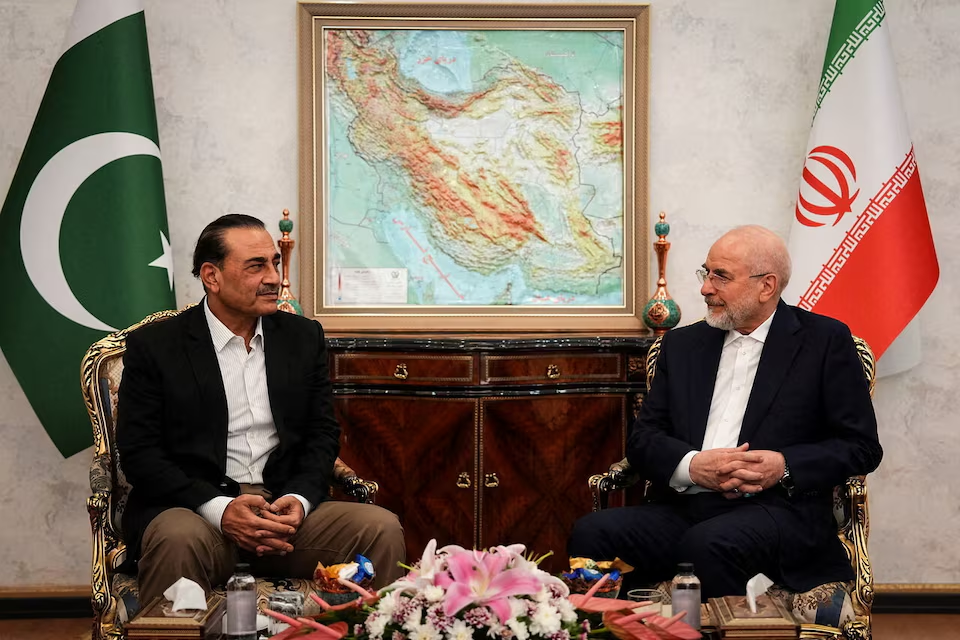
Europe, for its part, speaks the language of human rights yet continues to sell weapons and surveillance technologies. The Arab world, for all its proclamations of brotherhood, too often retreats into silence or self-interest, preferring trade agreements and security cooperation to the risk of moral leadership. Such selective empathy turns Palestinian suffering into a tolerated spectacle; broadcast nightly and forgotten by morning.
The Siege as Economic Warfare:
Long before the bombs fall, Gaza is strangled by a blockade that dictates what its people eat, build, and breathe. Cement, medical supplies, and spare parts are rationed like contraband. Farmers cannot export their crops; fishermen are shot at for crossing invisible lines in their own sea. The result is deliberate impoverishment: unemployment above fifty per cent, poverty above sixty, and near-total dependence on humanitarian aid.
When the power stations fail, incubators stop. When the crossings close, cancer patients die waiting for permits. These are not accidents of war but outcomes of policy, a slow violence that continues when the cameras are gone. The siege manufactures hunger and famine, and then condemns the hungry for desperation.
The Human Cost Behind the Numbers:
Walk through what remains of Khan Younis or Jabalia and the statistics dissolve into stories: a father searching through dust for the faint sound of his daughter’s voice; a nurse working by candlelight in a corridor that once was a ward; a teacher rewriting lessons by hand because every printer has run dry. Civilians push trucks and vans for want of fuel. These lives are not footnotes; they are the evidence of endurance.
And still, amid the rubble, the human spirit refuses extinction. Families share their last piece of bread; neighbours rebuild walls with bare hands. Gaza’s poets still write, its children still draw, and its prayers still rise. The world may view them as victims, but they insist on remaining human.
The Politics of Justification:
Each offensive arrives with the familiar refrain of “self-defence”. Rockets fired from Gaza indeed violate international law, but they do not justify the levelling of a city nor the annihilation endorsed by Mr Trump and his allies while the Arab League applauds. Proportionality, the cornerstone of humanitarian law demands distinction between combatant and civilian. Yet entire districts are treated as military zones. Every hospital, bakery, ambulance, university, mosque, and church becomes a target by association.
Governments speak of “surgical strikes” as if modern warfare were a clinical procedure rather than public punishment. Euphemisms like “collateral damage” and “neutralisation” mask what survivors know too well: war from the air is, by nature, indiscriminate.
Arab Silence and the Politics of Fear:
One of Gaza’s deepest wounds is the quiet of its brethren and neighbours. Many Arab leaders issue statements of concern while maintaining the very security coordination that keeps borders sealed. Others invest billions of dollars into the economies of the perpetrators whom they call friends. Their fear is not of Israel alone, but of their own peoples, who might see in Gaza’s defiance a reflection of their suppressed aspirations. Thus, solidarity becomes theatre, meetings, resolutions, and a studied avoidance of action.
The Moral Collapse of the International System:
The United Nations passes resolutions that gather dust. Western powers call for restraint while replenishing the arsenals that make restraint impossible. Human-rights organisations document violations, yet accountability remains a mirage. The International Criminal Court opens investigations that never reach verdicts. The so-called advanced nations of the West have placed ego above justice. What we witness is not merely a humanitarian failure but a crisis of civilisation, worsened by the emptiness of technological pride.
When rules are applied selectively and the powerful remain immune to consequence, law itself becomes an accomplice. The bloodletting and carnage in Gaza expose the fragility of the moral order we claim to defend.
Resilience as Resistance:
Amid deprivation, Gaza has become a symbol of endurance. With little more than conviction, its people insist on life, teaching, farming, praying, loving. Their resilience is often misread as militancy; it is, in truth, the only available dignity that remains. To survive famine and bombardment without surrender is an act of political defiance. Each family that rebuilds a home declares to the world that annihilation has failed. Gaza’s resilience is not born of ideology but of necessity, the simple human refusal to vanish, externated or annihilated!
Ceasefire Is Not Peace:
Even now, with guns momentarily quiet, the machinery of siege remains. Checkpoints, permits, and embargoes; the architecture of control, are untouched. Without justice and equality before the same law, a ceasefire is merely an intermission between tragedies. Reconstruction funds will trickle in, promises will be made and forgotten, until the next round of annihilation begins.
True peace demands the total lifting of blockades, the end of secret military restrictions, and recognition of Palestinian statehood. Collective punishment is a crime against humanity; the world must stop treating Palestinian suffering as background noise and start seeing it as a test of global conscience.
A Call to Conscience:
History will remember who spoke and who remained silent. The record will show politicians who justified the unjustifiable, media houses that balanced atrocity against talking points, and citizens who looked away. Yet it will also remember those who refused amnesia; journalists, doctors, faith leaders, and ordinary people who insisted that every life has equal worth.
Gaza is not a distant tragedy; it is a mirror. Its ruins reflect the consequences of our moral indifference. The question that remains is not what Israel or Hamas will do next, but what the world is willing to tolerate in its own soul. Can such carnage and bloodbath happen anywhere else? We are going for the inevitable day of reckoning; if not here, then there!


Leave a Reply