

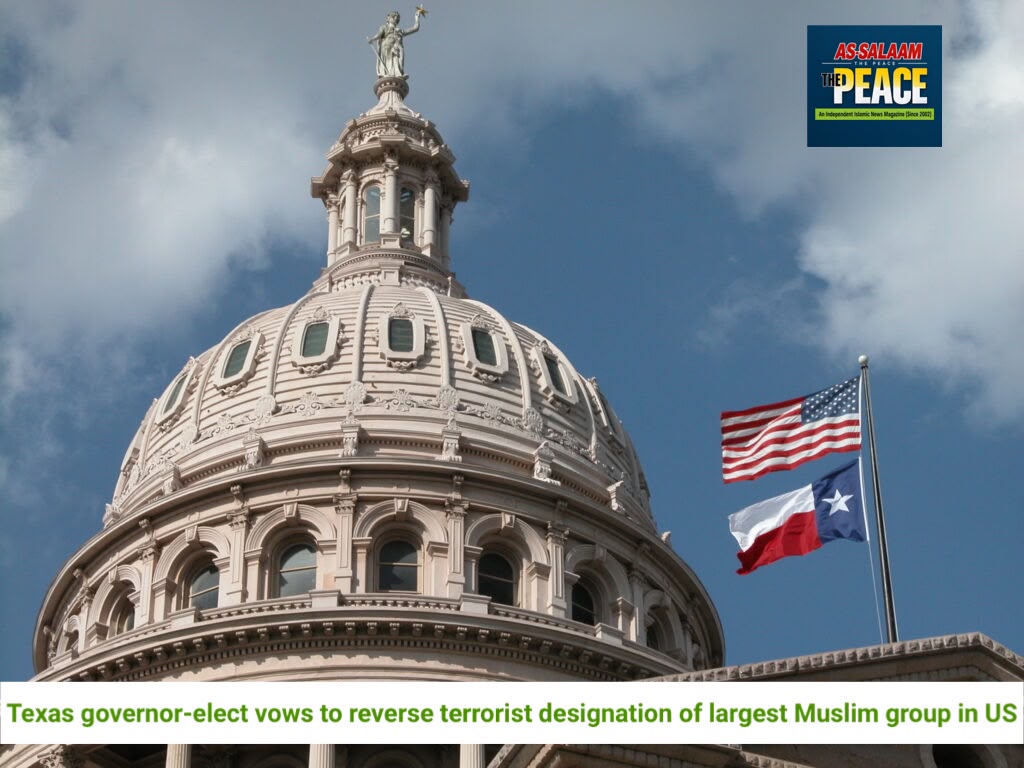
Gina Hinojosa says she will rescind outgoing Governor Greg Abbott’s order targeting the largest Muslim civil rights organisation in the United States when she assumes office in January.
By Abdullahi Yusuf
Texas governor-elect Gina Hinojosa has pledged to reverse her predecessor’s designation of the Council on American-Islamic Relations (CAIR) as a terrorist organisation, opening the prospect of a major policy reversal affecting one of the country’s most prominent Muslim civil rights groups.
In an interview with The Washington Post published on November 14, Hinojosa said she intended to rescind the order issued by outgoing Republican Governor Greg Abbott, arguing that public safety measures should serve their intended purpose rather than target nonprofit organisations.
“We have to use public safety measures for public safety,” she said.
Hinojosa, who defeated Abbott in the November 3 elections, is due to take office in January 2027. Her pledge would reverse a measure that has placed CAIR at the centre of a legal and political dispute over the treatment of Muslim organisations in Texas.
Abbott issued the proclamation on November 18, 2025, designating CAIR and the Muslim Brotherhood as foreign terrorist organisations under Texas law and as transnational criminal organisations under the state’s property laws. The order also sought to prevent the organisations and their affiliates from purchasing or acquiring land in Texas.
In justifying the measure, Abbott described CAIR as a successor organisation to the Muslim Brotherhood, an allegation the civil rights group has consistently rejected.
CAIR has denied links to terrorism and maintains that its work centres on defending the civil rights of American Muslims, challenging discrimination and protecting constitutional freedoms.
The organisation challenged Abbott’s action in court, arguing that the designation was unlawful and intended to undermine its advocacy.
The dispute escalated in February 2026 when then-Texas Attorney General Ken Paxton filed a separate lawsuit seeking a court declaration that would classify CAIR and its Texas affiliates as foreign terrorist and transnational criminal organisations, potentially preventing them from operating in the state.
However, Paxton’s office withdrew the lawsuit on November 16, according to court records. The withdrawal ended that particular legal action, but did not itself revoke Abbott’s executive order or resolve CAIR’s separate challenge to the governor’s proclamation.
Hinojosa’s pledge has been welcomed by CAIR and its Texas chapter, which urged other incoming state officials to end measures they say have targeted Muslim institutions across the state.
In a joint statement, the organisations described Abbott’s order as an attack on their civil rights work and said the November election had rejected efforts to use anti-Muslim sentiment for political purposes.
“Anti-Muslim hate is no longer an effective political weapon in Texas, and it must no longer have any place in state governance,” they said.
The incoming governor’s commitment comes as Democrats prepare to take control of the governorship and state House following their election victories. Republicans, however, retained their majority in the Texas Senate, which could complicate parts of Hinojosa’s legislative agenda.
Her proposed reversal of Abbott’s order is distinct from the broader legislative issues facing her administration, although the precise legal steps required to remove all consequences of the designation remain to be seen.
The controversy also has a parallel in Florida, where Governor Ron DeSantis and the state Cabinet designated CAIR and its Florida chapter as domestic terrorist organisations under a state law adopted in 2026.
On November 4, a federal judge, Allen Winsor, granted CAIR and its Florida chapter limited preliminary relief, preventing certain penalties connected with the provision of legal services, but declined to block the designations more broadly.
The organisations have challenged the Florida measures, arguing that they violate constitutional protections, including freedom of speech and due process. The court’s ruling did not settle those wider constitutional questions.
The developments in Texas and Florida have brought renewed attention to the legal boundaries governing state efforts to designate civil society organisations as terrorist groups, as CAIR continues to challenge the measures against it.


Leave a Reply